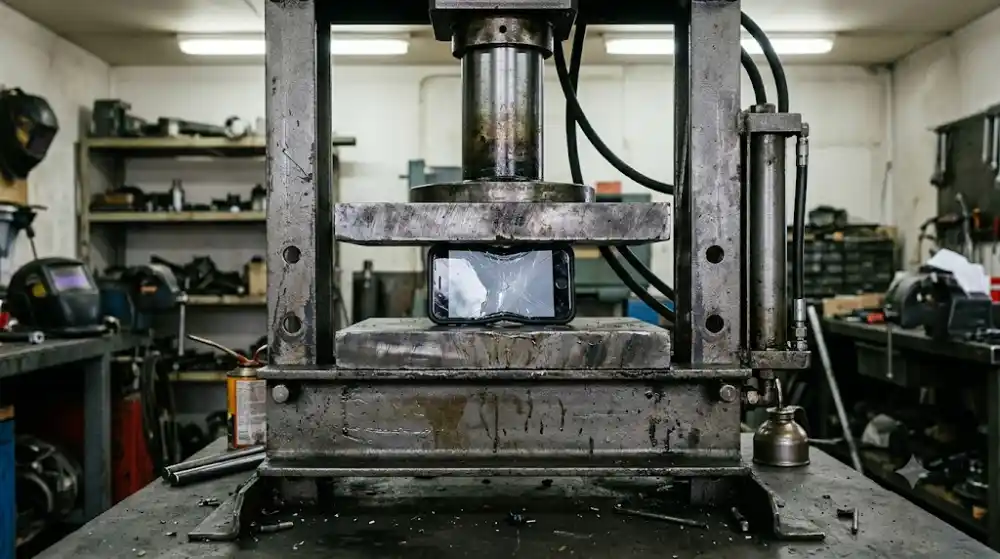
A hydraulic press slowly moving down to flatten an everyday item creates an immediate visual hook. Viewers do not need an explanation or background story; the curiosity starts the moment they see the object placed between two solid steel plates.
The prompt focuses on raw, hyper-realistic, documentary-style industrial footage—avoiding CGI effects, artificial lighting, or cartoonish explosions. In digital video creation, raw authenticity consistently commands higher retention than over-edited clips because it triggers genuine curiosity: how will this specific material break under extreme pressure?
What Is This Video Concept About?
The core idea is an unedited, real-time industrial experiment. An object—whether a smartphone, an alarm clock, a bowling ball, or a block of clay—is placed under a heavy-duty hydraulic press on a workshop floor. The camera remains fixed on a tripod, capturing the steady, mechanical descent of the metal plates until the object is completely flattened.
The appeal relies on three elements:
- Physics-driven curiosity: Viewers want to see the precise breaking point of materials.
- Sensory satisfaction: The mechanical hum, the crackling of deforming surfaces, and the final contact of metal plates provide an ASMR-like viewing experience.
- Zero friction: Because there is no dialogue or language barrier, the content connects with global audiences instantly.
Why This Content Works on YouTube
YouTube recommendations are shaped by viewer satisfaction, retention, and repeat viewership. This format naturally aligns with how audiences consume visual content:
- High Click Appeal: The concept is easily represented in a title and thumbnail. Seeing a fragile or rigid object placed under hundreds of tons of pressure creates an open loop that viewers want resolved.
- Natural Retention Curve: In an experiment video, the payoff happens at the very end when the object is fully crushed. Viewers tend to stay through the gradual deformation stage to see the final flat result, keeping average view duration high.
- Universal Reach: Visual experiment videos rely on sound design and physical action rather than spoken language, meaning a single video can attract viewers from any country without dubbing or translation.
Expected Audience Engagement Signals
Because destruction experiments generate varied emotional responses, user engagement usually manifests across specific behaviors:
- Rewatches: Sudden collapses, unexpected structural snapping, or rapid material oozing often prompt viewers to scrub back and rewatch the exact frame where the material failed.
- Comment Section Debates: Audiences often discuss material science, predict what will happen before the press hits, or comment on whether the crush met their expectations.
- Community Suggestions: Once a channel builds momentum around crushing items, viewers frequently leave comments demanding specific items to be tested in future videos (e.g., “Now try a Nokia 3310” or “Do a hydraulic press vs. a lithium battery”).
Platform-by-Platform Performance Potential
1. YouTube Shorts
Short-form vertical video is ideal for this concept.
- The First 2 Seconds: Start immediately with the hydraulic plate 2 inches away from the object. Skip the setup completely.
- Pacing & Loop Potential: Since the video ends with the plates fully touching, a seamless cut back to the descending plate can create an infinite loop that boosts replay metrics.
- On-Screen Text: A simple label like “Can 500 Tons Flatten This?” keeps the screen uncluttered while establishing the stakes.
2. Instagram Reels
Instagram rewards aesthetic satisfaction and shareability.
- Visual Polish within Realism: While the video remains raw, clean audio mastering for compression crunches and metal groans performs exceptionally well for ASMR communities.
- Share Potential: Viewers frequently DM oddly satisfying or surprising videos to friends with simple captions like “Look at how this cracked.”
- Save Rate: Compilations of multiple quick crushes (e.g., “5 satisfying crushes in 30 seconds”) generate high save rates on Instagram.
3. Facebook Reels & Video
Facebook’s audience leans heavily into shareable, relatable, and discussion-heavy media.
- Everyday Objects: Videos featuring nostalgic or common household items (vintage toys, locks, tools) generate strong emotional engagement and shares in mechanical and DIY groups.
- Pacing: Facebook audiences engage well with slightly longer 60-to-90-second versions that show the object inspection before the descent.
How to Create the Video Using the Prompt
Follow this straightforward production workflow:
- Choose the Object: Select an item with distinctive structural properties (brittle glass, dense wood, malleable metal, or soft polymer).
- Apply the Generation Prompt: Input the detailed prompt into your photorealistic video generation software, inserting your chosen object in place of
[OBJECT]. - Verify Physical Consistency: Check that the deformation respects real-world weight, density, and fracture points without artificial warping.
- Master the Audio Track: Layer realistic mechanical hums, hydraulic valve hiss, and distinct material cracking sounds. Keep the mix clean—avoid adding background music.
- Color Grade for Realism: Maintain flat, natural fluorescent workshop tones. Avoid cinematic color grades, high saturation, or dramatic shadows.
- Export Multi-Format Cuts: Export a 16:9 widescreen master for long-form YouTube and a 9:16 vertical crop for Shorts, Instagram Reels, and Facebook.
Target Audience Breakdown
- Demographics: Broad appeal, predominantly spanning ages 16–45 interested in DIY, engineering, satisfying videos, and science experiments.
- Viewer Intent: Entertainment, stress relief (oddly satisfying content), and casual scientific curiosity.
- Content Categorization: Sub-niches include Satisfying Media, Material Testing, ASMR Mechanical Sound, and Physics Experiments.
Building a Full YouTube Channel Around This Concept
A single crushing video is entertaining, but turning it into a sustainable channel requires structured packaging.
Strategic Channel Playbook
- Content Pillars:
- Extreme Resistance: Testing items people assume are indestructible (padlocks, industrial bearings, heavy-duty springs).
- Oddly Satisfying: Soft, ductile, or layered objects that deform smoothly (crayons, rubber blocks, honeycomb structures).
- Brittle vs. Ductile: Direct comparisons between two different materials crushed side-by-side.
- Shorts to Long-Form Pipeline: Use 30-second Shorts to capture high top-of-funnel reach, then produce 8-to-10-minute compilation episodes featuring 10 unique objects grouped by theme (e.g., “Crushing 10 Types of Industrial Locks”).
- Community-Driven Topics: Use YouTube Community tab polls and comment sections to let subscribers vote on next week’s object. This turns passive viewers into active participants.
Title & Thumbnail Strategy
Title Formats
- Hydraulic Press vs Solid Titanium Block (Real Workshop Test)
- What Happens When You Crush a Mechanical Alarm Clock?
- 100-Ton Hydraulic Press vs Hardened Steel Bearing
- Hydraulic Press Crushing Vintage Electronics to Dust
Thumbnail Design
- Visual Focus: Split-frame or single freeze-frame right at the point of maximum tension—just as the object starts fracturing under the steel plate.
- Lighting & Contrast: Clear, crisp foreground focus on the object with the metallic texture of the press visible.
- Minimalist Text: 2–3 words maximum (e.g., “500 TONS” or “WILL IT BEND?”) using high-contrast bold lettering.
Monetization Opportunities
- YouTube Partner Program: High-retention compilation videos generate steady ad revenue across broad global geographies.
- Brand Collaborations: Hardware manufacturers, phone-case brands, and protective-gear companies often sponsor stress-test videos to showcase product durability.
- Sound Library Licensing: High-fidelity Foley audio recordings of raw industrial crushes can be licensed to sound designers and game developers.
Common Mistakes to Avoid
- Adding Loud EDM/Background Music: This destroys the satisfying, ASMR nature of the mechanical sound design.
- Over-the-Top CGI Effects: Viewers instantly detect unrealistic physics; fake shockwaves and cartoonish fragments ruin credibility.
- Slow Intros: Spending 30 seconds explaining the machine before crushing the item causes severe early viewer drop-off.
- Misleading Thumbnails: Showing an explosion on the thumbnail when the actual video shows a slow compression creates viewer dissatisfaction.
Final Takeaway
The strength of realistic industrial destruction content lies in pure, unhurried physical interaction. By staying committed to authentic visuals, raw workshop audio, and clear structural testing, you build a channel grounded in universal curiosity. Focus on clean sound design, prompt delivery of the visual hook, and consistent viewer-suggested items to turn casual viewers into long-term subscribers.
Frequently Asked Questions
Can this type of content work without speaking or showing a face?
Yes. The entire appeal is visual and auditory. Faceless channels in the material-testing niche perform exceptionally well because the machine and the object are the sole focus.
How long should a standard long-form video be?
Individual tests work best between 45 and 90 seconds. For standard YouTube long-form uploads, compile 8 to 12 tests into a single 8-to-10-minute video around a unifying theme.
Why is realistic sound design so important here?
Audio drives a significant portion of viewer retention in destruction and experiment videos. The crunch, mechanical hum, and metal-on-metal impact deliver the primary sensory payoff.
Should I add slow-motion replays?
Yes, but only for materials that shatter rapidly (like tempered glass or ceramics). Run the real-time crush first, followed immediately by a single close-up slow-motion breakdown.
How do I prevent content from becoming repetitive?
Vary the physical properties of the items tested. Alternate between brittle ceramics, elastic rubbers, dense metals, and complex multi-layered objects to ensure every crush looks and behaves differently.